Wednesday, July 7, 2010

THE HORSE SHOW


In our historic neighborhood we have an alley. In the late 1800’s alleys served many purposes. Kids played 'stick ball" in them, neighbors called to neighbors across them, incinerators burned trash and leaves there. They were also primarily made for the delivery of goods by horse drawn wagons. Our back alley building served as a shed for the coal hauler to deliver his black chunks by horse wagon for the coal furnaces around town. Today that shed is a miniature art gallery called “Gallery O”.  

Recently we had our sixth “sort’a annual” alley party there for friends and the neighborhood. We do this as a way of getting to know our neighbors, catching up with the friends and creating a community of people that wave to each other. It just seemed like a good idea a while back. In the old days people would sit on their front porches every day at dusk and ‘shoot the breeze’ with whoever walked by. It was particularly popular on Sunday evenings. It is what people used to do back before the media took over our lives and made us all shut ins watching the evening news instead of the light glancing off the Flatiron rocks over the city here.

For the party we block off our alley and put out furniture, tables, chairs, rugs, lamps, a big tent we that doubles as a ‘Play Sail” kite, ping pong tables, banners and whatever else we can find to make this most communal space comfortable and fun for a summer evening. People bring food, drinks, a friend, a story, a song, a game or…. “a horse” ...this year’s theme. We open our studio and show kids films in the “Alley Cat Theater”, and, this year, had a show  at our Gallery O called “The Horse Show” and invited children, artists and non artists to bring something with a horse in it. Many of neighbors and friends brought works on or about horses. Our next door neighbor even brought three real horses to the delight of everyone, especially the children. There were two miniature ponies for petting and one riding pony whose owner walked the wide eyed riders around the block on.


pony rides were given to the kids

The alley set up just before guests arrived and the rain hit


One of the hits of the night was the firing off of about eight pressurized water bottle rockets made by some of the family members who came and other friends who took up the challenge. They streamed into the sky spraying a trail of water mist, some ricocheting off the overhead cables to the delight of the ducking audience. Luckily they didn’t spook the horses into a stampede through the food table.

The Horse Show gathered an eclectic mix of works as anticipated with some really wonderful things. Below are some of the images from the gallery walls. People brought photography, drawings, prints, sculptures, there was even a horse headed human who paraded through the crowd. 


Half a Horse - Sandy Hale


Capriole - Pam Capozolla


Light Horse - Melanie Walker + George Peters


Light Horse 3 - Melanie Walker + George Peters


Scorpio Rising - Sherry Hart


Italian Stallions - Melanie Walker


Eye Chart - Melanie Walker


Chance - Sherry Hart


Lukas Bachmann - age 8


Horse Hinge - collection of Joanne Grillo


Rocking Horse Toy - collection of Peters+Walker


Galloping News - George Peters


Richard Block - collection of Joanne Grillo


Horse & Moon - Carol Bachmann
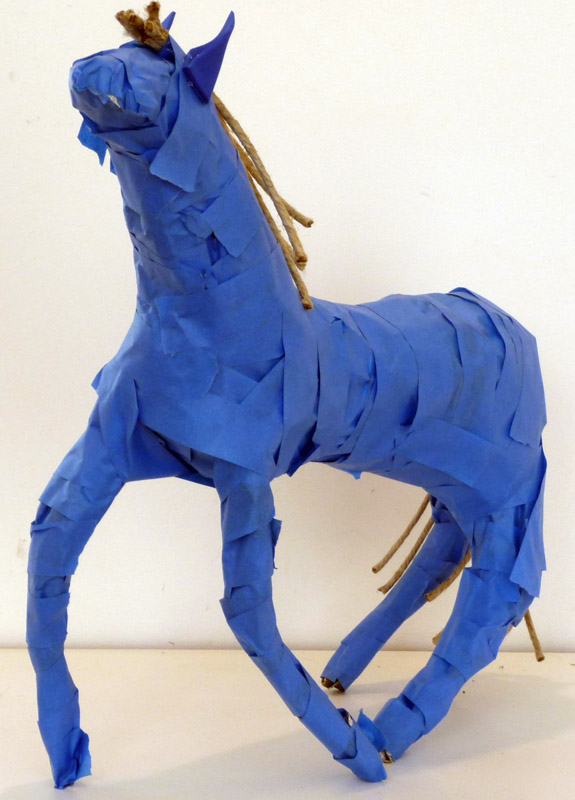


Blue Horse - Melanie Walker


Trojan Horse - Oliver Hart - age 8


Sanjay wearing the Horse Head


For the photo frame images go to the slide show  as well as a parade of our lead toy horse collection  

Tuesday, February 9, 2010

EXTREME MINIATURISTS

In every occupation there are the extremists. There are extreme sports that put one as close to death as possible. There are religious extremists who push the letters of the holy law to stretch the principles of common sense. I’ve run into extreme kite makers who battle for the largest kite in the world award and get carried away by their creations. There are extreme makeovers, extreme pumpkins and extremely rude people.

In the miniature world, there are, of course, extreme miniaturists. These are people who make very, very small objects by hand usually using microscopes and very steady hands. When I was working in Hawaii at a tourist marketplace as a sidewalk portrait artist, at the stand next to me was a man who painted miniature artworks on women’s fingernails. One day he showed me his other passion …making incredibly small sculptures out of a grain of rice. I was amazed. He showed me tiny little figures that could fit into the eye of a needle and even a miniature replica of the Taj Mahal smaller than a pinky fingernail clipping.

I recently stumbled upon the works of two extreme miniaturists. They both work microscopically, that is, aided by the strong vision of microscopes. The works are incredibly small. Most fit easily into an eye of a needle and can be accidentally blown away by a careless sneeze or inhaled. The sculptures are carved using hand made tools of even smaller proportions. They are painted, in some cases with a brush made from a hair off of a fly’s back. In order to carve them, particles are scraped a micron at a time with a deft precision that baffles imagination. The carving is done between heartbeats so the fingers don’t topple the sculptures off of their perch and loosing them forever.

Willard Wigan is a micro-miniaturist. His works began when he was a child who had learning disabilities and undiagnosed dyslexia. To avoid the difficulties and harassments in the English school system he would escape to a small shed in the backyard of his home and watch a line of ants working. Feeling like he was also as insignificant as these humble creatures, he started making things for the ants, like tiny little houses and then little shoes and hats for them. His mother discovered his secret hideaway one day and he was punished but it didn’t stop his fascination with these miniature worlds he could create.


Hagop Sandaldjian excelled in mathematics and music in Egypt and mastering in the miniature fingering required to play a viola poprosa, a 20 inch violin. Later on in life he used his skills of obsessive controlled movement in carving incredibly small sculptures. Sandalldjian employed self-made tools made from sharpened needles tipped with diamond or ruby dust, constructing his sculptures out of miniscule materials such as dust, lint and hair.


Are they art, craft or extreme novelty? In an age of the micro-miniature when even the most mundane of everyday objects, the ubiquitous cell phone rings in most pockets and purses, we have accustomed ourselves to small wonders filled with nano-scale circuitry and incomprehensible electronics. We have lost the wonder of the hand made. Its hard to compete against the research that’s going on to create molecular mechanical gears and circuits so small they are invisible to all but an electron microscope's gaze. But for the efforts of the extreme miniaturists they have inspired wonder at all things handmade to the beat of a heart.

BIRD HOUSE

When we started the Gallery O in the fall of 2008 and the track lights came on the lights in our heads came on as well. We realized that such a small space could contain, perhaps, some really big ideas. Shows were planned for the year with an unrealistic schedule of one show a month with openings, refreshments and crowds of people attending. It would certainly keep us busy on top of our already packed schedule.

With that said, the ‘Bird House’ show is the first gallery show since last summer. It is an installation of birds inside the gallery from our collections. Bird mobiles circle in the space and fly on pedestals, wooden crows line the shelves, mechanical birds chirp and tweet when someone enters the room setting off light sensors, and miniature wood houses are arranged along the shelves between the birds.

It may be a reference to the Alfred Hitchcock film, ‘The Birds’ that still haunts or merely a light hearted romp in avian pleasures. As the bird mobiles turn sunlight is caught and throws bird shaped reflections and shadows across the walls. Occasionally a shaft of light hits the sensors on the birds and they start a small private conversation about it.


Another newsworthy development and addition to the Gallery O happened last fall with an extension to the gallery space. How soon we outgrow the meager 8’ by 10’ gallery! The patio gathering space proved too difficult during the cold winter months here to have wine and refreshments for the openings. We have now enclosed the area and made it into a solarium and greenhouse more than doubling the Gallery O space. Now the walls are lined with plants and will soon be fitted with exhibition panels to extend the available wall space for future shows.


Stand by for the next phases of Galley O's future growth. Hmmm... The exclusive Cafe O with very limited seating and maybe even a conference space and convention hall.

Sunday, April 12, 2009

TINTYPE PHOTO - Through the Lens in 1860


There is something that happens when you gaze at a photo of a person’s face. The presence and personality make a mark of recognition, even with strangers and people unfamiliar with our own lives. This connection spans generations. Going back in time we can see how the faces are etched with the concerns of the day, how the innocence shines in the face of a child, the look of hope mixed with fear on a twenty year old bride and the wisdom of the aged reflected through wrinkled eyes. A photo brings us to our common humanity.

The tintype photo process was the cheap and accessible form of photography in the mid 19th century America. Tintype photography, also known as melainotype and ferrotype was first described by Adolphe-Alexandre Martin in France in 1853 and patented in the United States in 1856 by Hamilton Smith, a professor at Kenyon College in Ohio. Previous techniques pioneered in France for commercial use were copper plate Daguerreotypes in 1839 and glass plate Ambrotypes in 1854. These techniques evolved to using tin plates, a cheaper and more durable technology at the time. The tintype was actually on iron that had been coated with black enamel. The plate was coated with wet collodian and a light sensitive silver nitrate for exposure inside the camera.

The process was simple, fairly inexpensive compared to other previous photo processes and made accessible to eager photographic subjects willing to give a few silver coins in exchange for a portrait. Tintype photographs were, mostly, an American phenomenon. In the years of the Civil War tintype photographers set up at carnivals, on river boats, Northern and Southern war encampments and most places where they could find eager customers. People posed in the photographer’s tent studios, with painted backdrops mimicking the formal painter’s aesthetic for portraiture. The subjects would bring their own props and dress according to their “Sunday best”. The exposures were long by today’s standards and forced the sitters into uncomfortable positions. The photo subjects have expressions of seriousness or even a dower look. Most people had never before posed for a photograph by a professional photographer using a mystical system of glass lenses and an alchemical array of ingredients. It was a serious matter. It was like being confronted by a three legged mythological Cyclops. Very few tintype photos from the twenty year period that this process reigned show spontaneous snapshots from actual non-posed life.


Floating river boat photography studio in the 1860's


Some cameras used multiple lenses to expose two or more images at once on the tin plates. These were then cut roughly with tin snips and placed into either a paper frame or, for an extra price, into elegant small hinged leather and gilded copper frames. Since these photos were generally small in size, they could fit into a locket or could be sent easily by mail inside an envelope. For the first time, having a portrait made was no longer the privilege of the wealthy class only. Anyone could have their photo taken.

These images were drawn from Melanie Walker’s collection of tintype photography and gathered since the mid nineteen seventies. They were found in antique shops from coast to coast and across the country. Some were found recently on EBay. What may stand out is that these photos are of ‘rescued’ ancestors. They are photos abandoned by their families for whatever reasons and left for the larger world to gaze upon. Whether the eye to eye connection is made while thumbing through a family album in a second hand shop or on the wall of a museum photographic exhibit, the recognition is still evident. Here is a picture of a life that was lived gazing out at a world not so different. Today’s photo technology is only slightly faster and more easily disseminated by emailing digital photos of the new baby or sharing a friend’s face on a social networking site. Where will our photos be in 150 years time? Will our portraits look out at a very different world that would then reflect on our simple and primitive means of showing our faces?


The following tintype photos are samples from the show. There are approximately one hundred and twenty images in the exhibition. Most are very small at between 3" to 1" square.


For more images from the show and other researched tintype photos go to the Gallery O Flickr slide show
The show opens April 17th and continues through May.